|
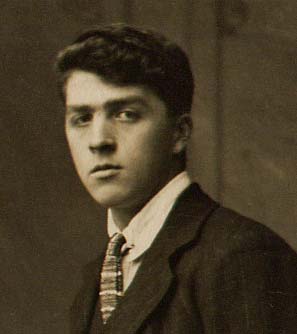
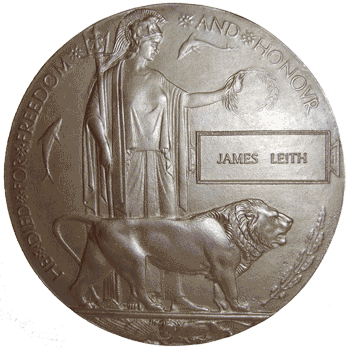
Private James Leith, 24th Battalion,
Machine Gun Corps (Inf)
James
Leith, the third son son of John and Jane Leith, was born
on 3rd November 1897 on the family farm of Courtieston, Leslie.
John Leith died at Courtieston aged only 43 in 1904. Shortly
after, his widow and four sons moved to the farm of Piperwell
at Duncanston, Kennethmont. It was from Piperwell that James
and his elder brother John left to go on active service. John
served in the Royal Field Artillery and was also killed
in action. This accounts for the brothers being commemorated
by name on both the Leslie and Kennethmont War Memorials.
James
was working as a farm servant at Newbigging, Leslie when he was mobilized and posted to the 3rd Battalion Gordon Highlanders at Aberdeen on 30th Nov 1916. He had already enlisted for Military Service in June 1916 and was given
the service number 15919 shortly after universal
conscription came into effect with the Military Service Act
of May that year. Conscription applied to all men regardless of marital status between 18
and 41 years. Working at home on the farm may have been classed
as a ' reserved occupation ' prior to this date.
While
with the Gordons James became a member of the battalion's
specialist Machine Gun (M.G.) section. on 11th February 1917 he was transferred to the Machine Gun Corps ( MGC ) and trained at Grantham.
At
the beginning of WW1 each infantry battalion was equipped
two Maxim Machine Guns served by of an officer and twelve
other ranks. This was increased to four guns in February 1915.
However, production of weapons did not keep up with the expanding
army, and the BEF was still 237 guns short of the full establishment
in July 1915. The Vickers Company could, at most, produce
200 new weapons per week, and struggled to do that.
The
experience of fighting to date had proved that machine-guns
required special tactics and organisation. The BEF established
a Machine-gun School at Wisques, SW of Calais to train new
regimental officers and machine gunners, both to replace those
lost in the fighting to date, and to increase the number of
men with MG skills. A Machine Gun Training Centre was also
established at Grantham, Lincolnshire.
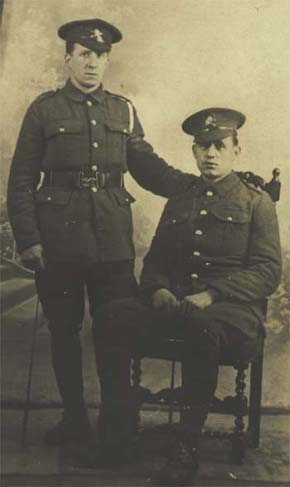
Unknown
members of The Machine Gun Corps
|
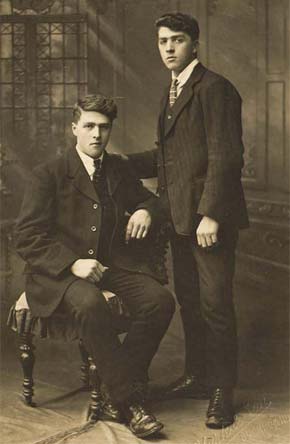
John
and James Leith
|
On
2nd September 1915, a definite proposal was made to the War
Office for the formation of a single M.G. Company per Brigade,
by withdrawing the Vickers guns from the Battalions. They
would be replaced at Battalion level by Lewis guns. The Machine
Gun Corps was created by Royal Warrant on October 14th, 1915,
followed by an Army Order on 22nd October. The MGC would consist
of infantry machine-gun Companies, cavalry machine-gun Squadrons,
and Motor Machine Gun Batteries. The pace of reorganisation
depended on the rate of supply of Lewis guns. It was completed
before the Battle of the Somme. The Base Depot of the Corps
in France was established at Camiers, close to the Infantry
Base Depot at Etaples.
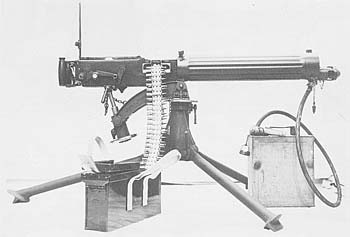
The
Vickers .303 Machine Gun - Mk 1
The
Vickers Machine Gun, which became a standard gun with the
British Army for the next five decades, was fired from a tripod
and cooled by water held in a jacket against the barrel. The
gun weighed 28.5 pounds, the water another 10. The tripod
weighed 20 pounds. Bullets are assembled into a canvas belt,
which held 250 rounds, which would last 30 seconds at the
maximum rate of fire of 500 rounds per minute. Two men were
required to carry the equipment, and two the ammunition. A
machine gun detachment also had two spare men.
The
original 72nd and 73rd MG Companies Joined the 24th Division
on 14th March 1916 at Ouderdom, Belgium. They moved into No
24 Bn, MGC on 5th March 1918.
On 10th August 1917, as a member of 5th Battn MGC, James landed at Boulonge and arrived at the MGC Base Depot at Camiers the following day. He joined the battalion's No 17 company in the field on 25th August.
|
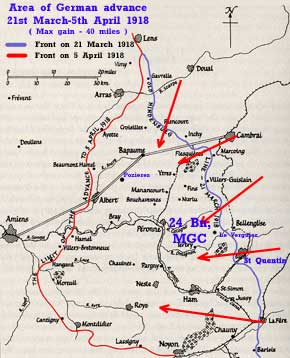
Click
on image to view large map.(48k)
|
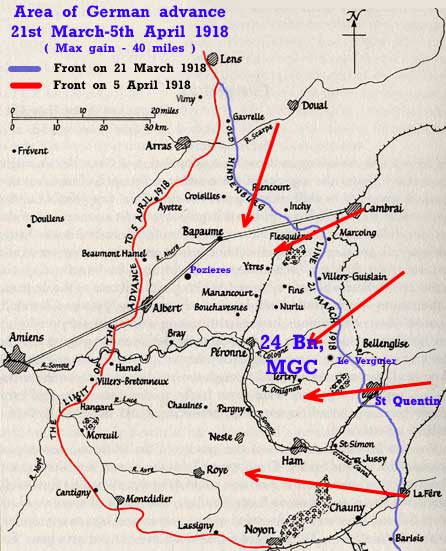
The
German High Command had carefully planned to launch a massive
offensive, codenamed Operation Michael, from the Hindenburg
defences in 1918. The Germans withdrew to these defensive
positions in March / April 1917.
When
it became apparent late in 1917 that America would join the
Allies, sending soldiers in great numbers, they decided to
move at the beginning of the year when the worst of the winter
weather had passed.
The
Hindenburg Line, or Siegfried Stellung as they called it,
was a vast system of defences in Northern France constructed
by the Germans during the winter of 1916-17. It ran from a
position east of Arras all the way to beyond St Quentin on
the British sector, and consisted of deep and wide trenches,
thick belts of barbed wire, concrete machine-gun positions,
concrete bunkers, tunnels and command posts. It was considered
virtually impregnable by the Germans.
The
British offensives during the summer of 1918 were to prove
otherwise.
|
James
Leith was killed in action on his 224th day in France during the The Battle of Saint
Quentin ( 21st - 26th March ) at the beginning of The German
Spring Offensive ( 21st March - 5th April 1918 ) when the
Germans broke through the British front and overwhelmed the
defenders. Following a short, intense bombardment, three German
armies (70 divisions), 1700 artillery batteries, and 1000
aeroplanes struck along a 45-mile front near Arras. Within
48 hours, the Germans had penetrated 10 miles, the greatest
single day’s advance on the Western Front since 1914.
In just three weeks the German army overran over 1500 square
miles of territory, including the former Somme battlefields,
a gain unequalled since 1914, before they were finally halted
on 5th April having pushed the front line back 40 miles.
They failed, however, to reach their ultimate objective, Amiens,
with its vital rail links to the Channel Ports, Paris and
beyond. This ultimately meant that Germany could not win the
war.
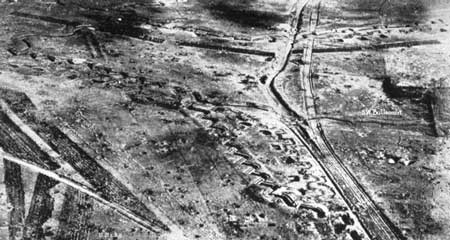
A section
of the Hindenburg Line to the north of Morchies
It is known that at the opening of this action the 24th Division
were in the line at Le Verguier to the south east of Arras.
They fought a fierce battle to defend the village but were
eventually overwhelmed and the line broken. At the sharp end
of the defensive line their Machine Guns were positioned both
to obstruct the attackers as well act as a buffer to allow
troops to withdraw behind them and regroup.
In
this way they became the first obstacle the advancing Germans
had to overcome and put out of action. The guns and their
crews became targets of every available enemy weapon.
On
the same day Lt Allan Ebenezer Ker, 3rd Battalion Gordon Highlanders,
attached 61st Battalion MGC (Infantry) was awarded The Victoria
Cross for his actions near St Quentin.
Lt Allan Ebenezer VC
Born
5.3.1883 / Died 12.9.1958
London Gazette 4/1/1919 - Citation
For conspicuous bravery and devotion to duty. On the 21st
March, 1918, near St. Quentin, after a heavy bombardment,
the enemy penetrated our line, and the flank of the 61st Division
became exposed. Lieut. Ker, with one Vickers gun, succeeded
in engaging the enemy`s infantry, approaching under cover
of dead ground, and held up the attack, inflicting many casualties.
He then sent back word to his Battalion Headquarters that
he had determined to stop with his Sergeant and several men
who had been badly wounded, and fight until a counter-attack
could be launched to relieve him. Just as ammunition failed
his party was attacked from behind with bombs, machine guns
and the bayonet. Several bayonet attacks were delivered, but
each time they were repulsed by Lieut. Ker and his companions
with their revolvers, the Vickers gun having by this time
been destroyed. The wounded were collected into a small shelter,
and it was decided to defend them to the last and to hold
the enemy as long as possible. In one of the many hand-to-hand
encounters a German rifle and bayonet and a small supply of
ammunition was secured, and subsequently used with good effect
against the enemy. Although Lieut. Ker was very exhausted
from want of food and gas poisining, and from the supreme
exertions he had made during ten hours of the most severe
bombardment, fighting and attending to the wounded, he refused
to surrender until all his ammunition was exhausted and his
position was rushed by a large number of the enemy. His behaviour
throughout the day was absolutely cool and fearless, and by
his determination he was materially instrumental in engaging
and holding up for three hours more than 500 of the enemy
A total
of 170,500 officers and men served in the MGC of which 62,049
became casualties, 12,498
being killed. They
well earned the nickname ' The Suicide Club '.
Created
in time of war the Machine Gun Corps was disbanded in 1922.
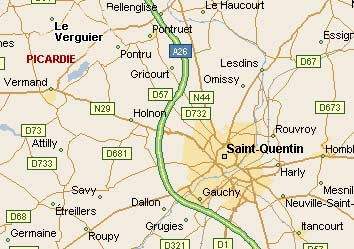
Location
of front line held by the 24th M.G.C. in 24th Division on
21st March 1918
James
Leith has no known grave. His name is recorded with over 500
of his Machine Gun Corps comrades on The
Memorial to the Missing at Pozieres.
Two more men from Kennethmont fell in the same area during
the 1918 Spring Offensive and also have no known grave.
John
Stewart from Haremyre with 7th Gordons also fell in action
near St Quentin the following day, 22nd March. His neighbour
from Braefolds, Alexander Pirie
fell on 25th March serving with the 6th Gordons trying to
halt the advance near Sailly.
Their names are recorded on The
Memorial to the Missing at Arras.
|
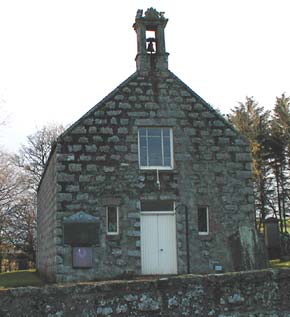
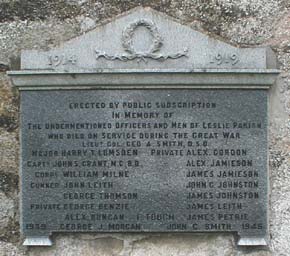
Leslie Kirk
and War Memorial
|